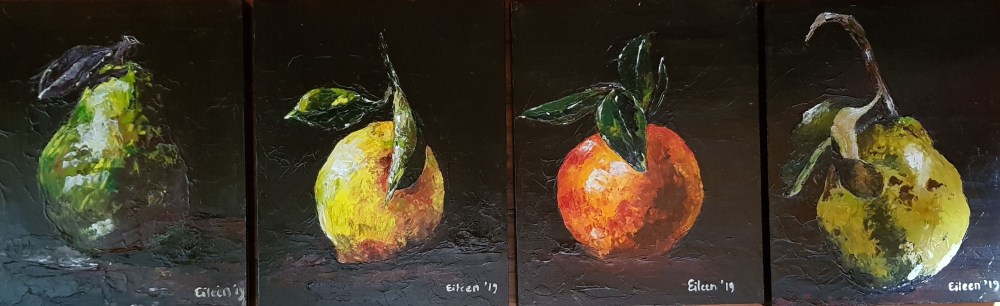
A palette knife is a blunt tool used for mixing or applying paint, with a flexible steel blade. It is primarily used for mixing paint colours, paste, etc. The palette knife is a very versatile instrument and is not just a tool for mixing paint on your palette. A palette knife can be used to create some pretty stunning effects, which are not possible with a brush. The paintings in this blog of various fruits have all been created using only a palette knife.

These are my larger palette knives. I used to use them for very large textured landscapes, and then mainly for the application of modelling pastes and mixed mediums. I use them less now as I work on a much smaller scale.

Above are a few of my favourite palette knives. Ive tried the fancier shaped ones, but I return to my old favourites. Depending on what I am painting I find some shapes more suited to the area of application than others. The first 4 (from the left) are the ones I use the most. The one I use the least is probably the one on the far right. I think I bought it for a one off project and then never used it again.
The advantages of a palette knife:
- It is so easy to clean a palette knife. You literally just need one wipe with a cloth or paper towel and all the paint is gone. This is a huge advantage over brushes, which require much more care.
- A palette knife, if you look after it lasts a lot longer than a paint brush does and can tolerate a lot more abuse too!
- It is great for building up a thick texture (impasto) and creating a broken colour effect.
- You can use the edge of the palette knife to create sharp lines.
- The bold strokes created by the palette knife can complement the more delicate strokes created by the brush.
- You can paint on top of wet layers without having to worry about the paint blending (like it does with your brush).
Disadvantages:
- You are not able to paint with as much accuracy using a palette knife, but sometimes you don’t want that. I am using a palette knife to try to force myself not to be so anal about blending.
- It is not as versatile as a brush. That said though, I don’t see myself ever just using a palette knife. I quite like combining the two tools.
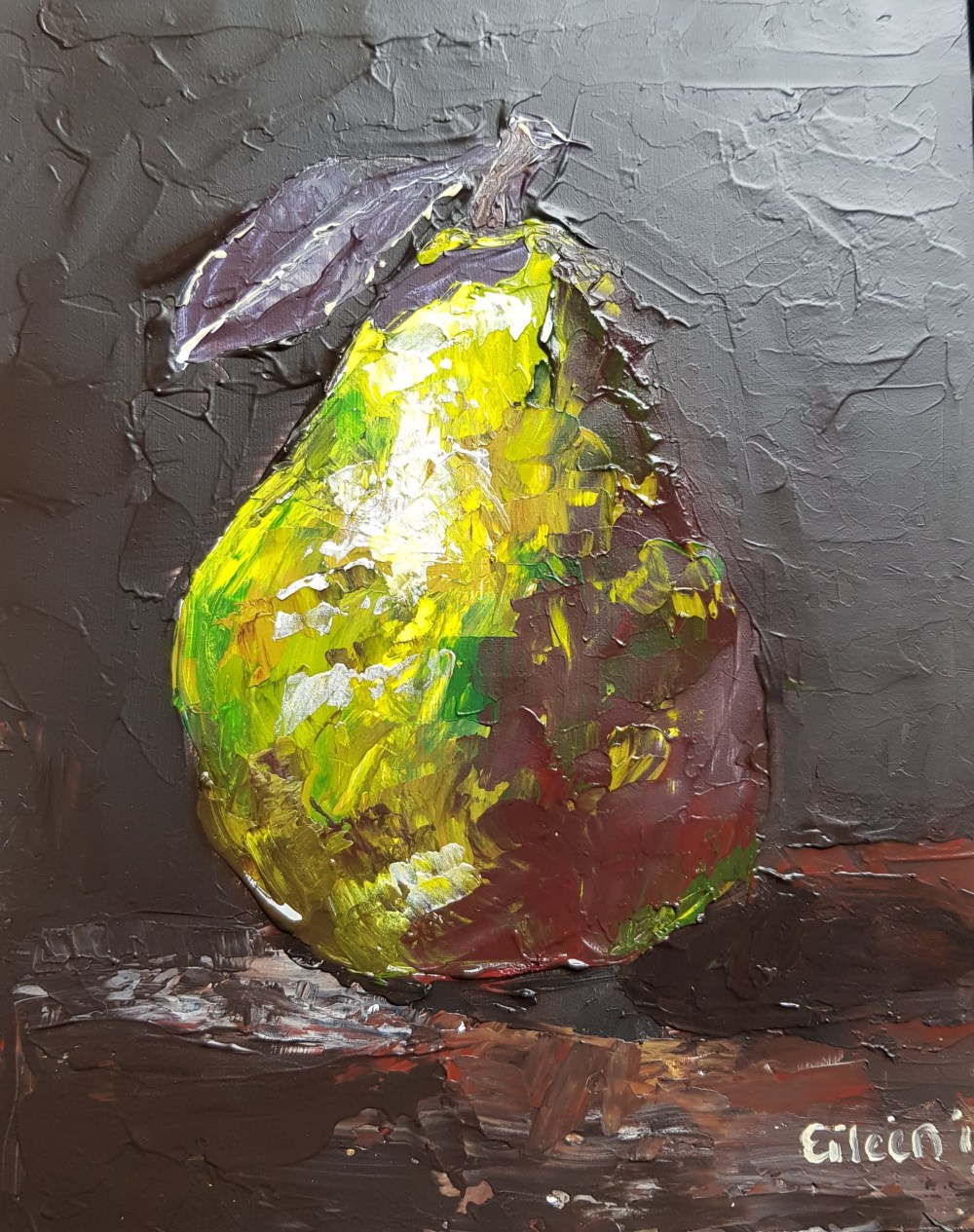
Pear
Acrylic on pressed board
Underpainting in yellow ochre
Application with palette knife only
20 X 25 X 3 cm


What one should look for in a palette knife:
- A flexible, but sturdy blade.
- A comfortable handle.
- One side at least should have a long straight edge.
- You do not need any unusual shapes. Just a standard-shaped palette knife in a few different sizes is more than enough. I do have a few fancy ones that I play with, but that largely depends on the size of the canvas I am working with. In reality, they are hardly ever used.
- If you are working with modelling pastes and textures you will need a sturdy palette knife. When I used to do my textured landscapes with the calligraphy camels I relied heavily on some of my larger more unusually shaped palette knives.
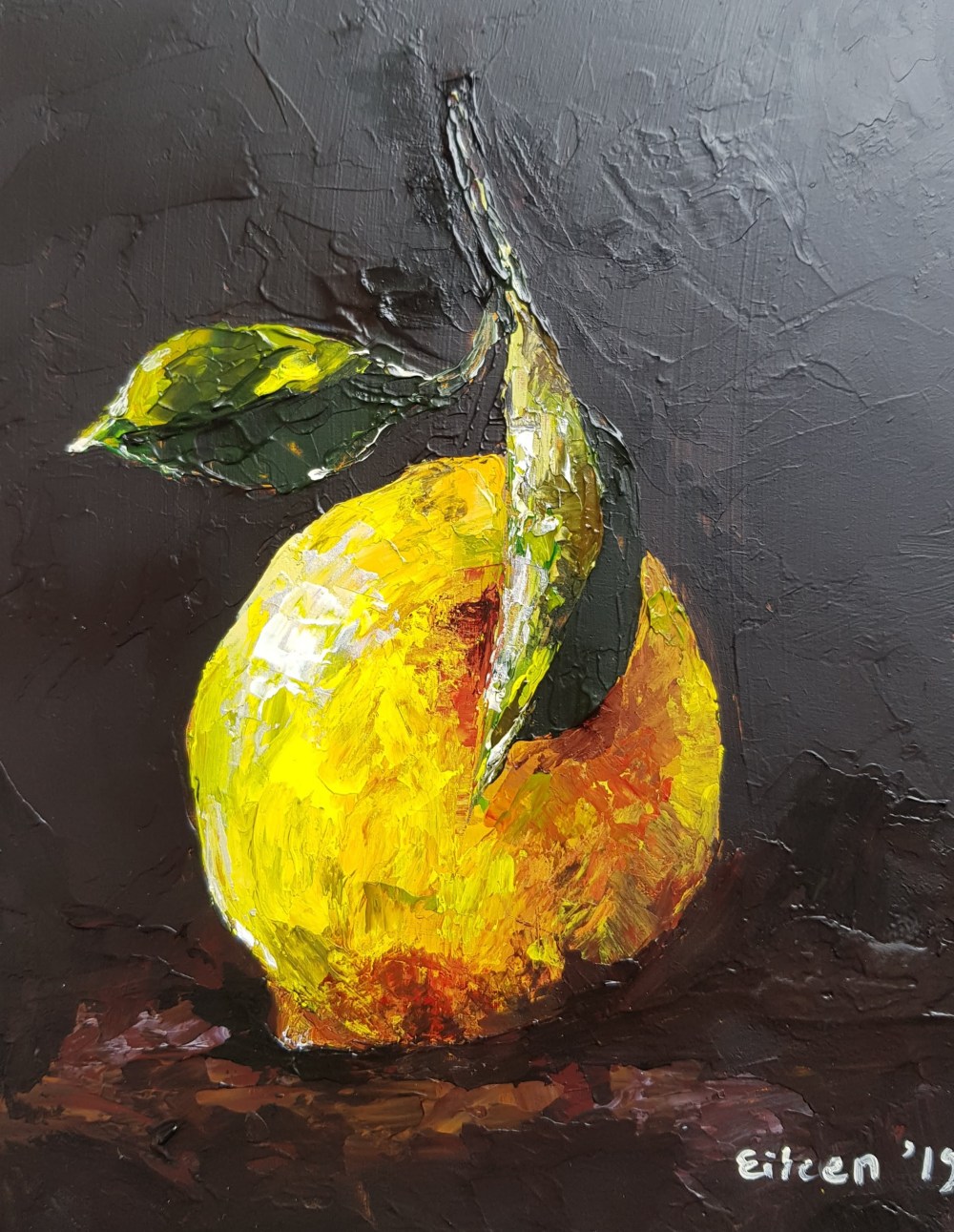
Lemon
Acrylic on pressed board
Underpainting in yellow ochre
Application with palette knife only
20 X 25 X 3 cm


Creating with a palette knife:
A palette knife can be used to create thin, usually broken lines which can look very natural in a painting. Often, especially in a landscape lines are broken by foliage, shadows etc. Very rarely is it a solid line and the palette knife is great for capturing this. All you need to do is load the edge of the palette knife with a thin amount of paint and then dab the edge on the canvas. Just make sure the paint is evenly spread across the edge of the knife. Usually, you will only get one line per stroke, which means you will need to keep reloading your palette knife between strokes.
A short blade produces angular strokes.
A long blade makes it easy to put down sweeps of colour.
A rounded blade is great for dabbing spots of pigment and building layers.
A sharp-pointed blade allows you to scratch into the paint for sgraffito effects. (Sgraffito is a form of decoration made by scratching through a surface to reveal a lower layer of a contrasting colour).
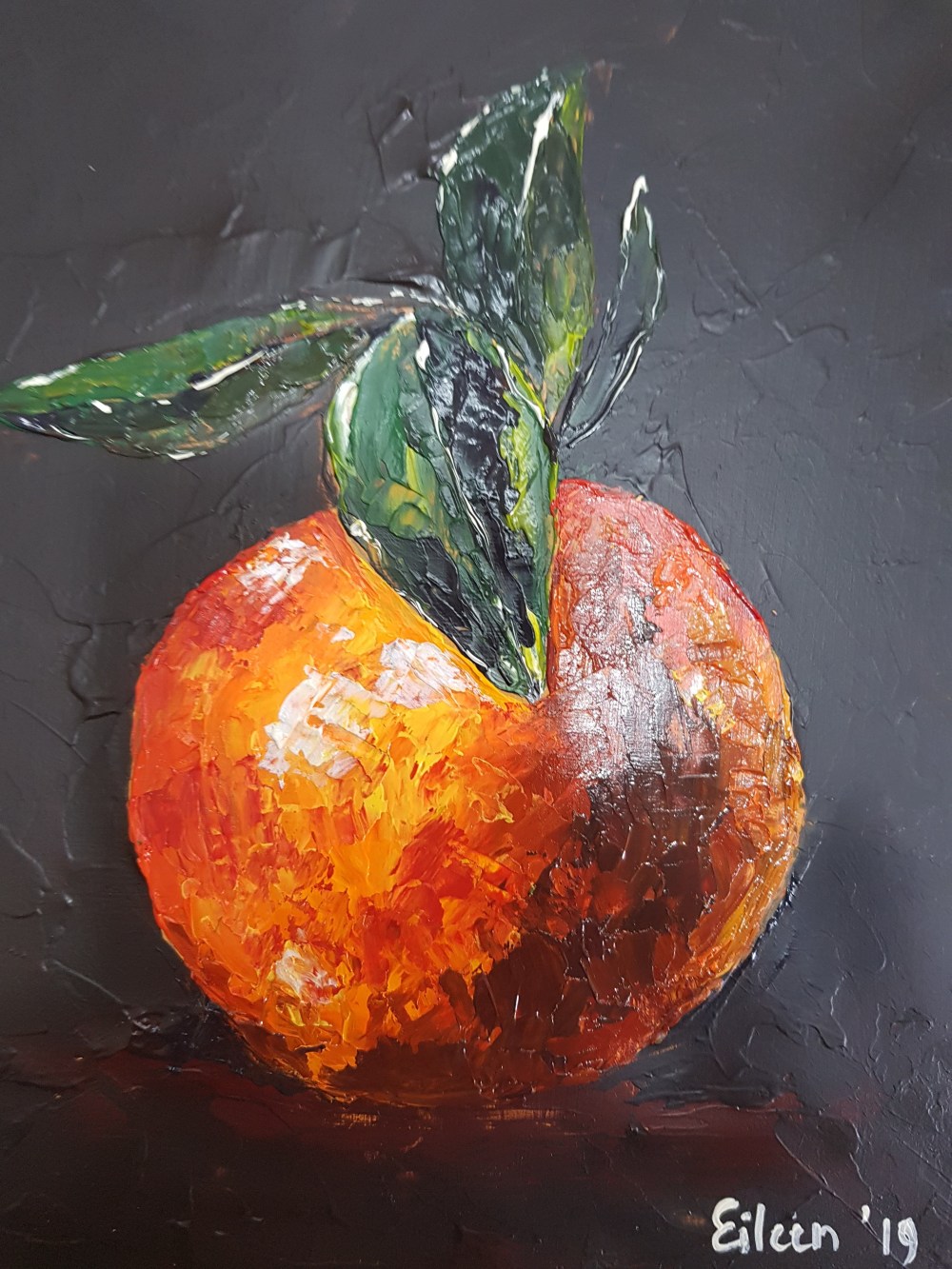
Orange
Acrylic on pressed board
Underpainting in yellow ochre
Application with palette knife only
20 X 25 X 3 cm


Dragging one colour into another:
The palette knife is a wonderful tool for blending edges by dragging one colour into another. What you are left with is a very rough and scattered edge. If you were to do this with a brush, you would get a much softer edge.
Scraping away paint to fix errors or add details:
This is where the palette knife becomes the star of the show! You can scrape away paint from the canvas to clear an area where you went wrong.
You can also use the palette knife to scrape details into your painting. For example, you could scrape away a thin line of paint to imitate a tree branch. When doing this, you just need to be aware of what colour will be exposed in the underpainting. Underpainting comes in handy here as you will get some nice earthy colour exposed rather than just the glaring white of the bare canvas. Depending on what I am painting my underpainting colours will differ. For these four fruit I used yellow ochre as an under painting colour on the board.
Multi-coloured palette knife strokes:
This is a great technique. Just take a few different colours and mix them together, but not that thoroughly. Then take your palette knife to smear the paint on, much like you would when buttering bread. The result is a thick stroke of broken colour. I also on occasion depending on the subject matter leave the paint partially mixed on the palette and then when I spread the paint onto the canvas it mixes unevenly and gives a lovely natural feel and breaks the solidity of a single flat application of one colour.
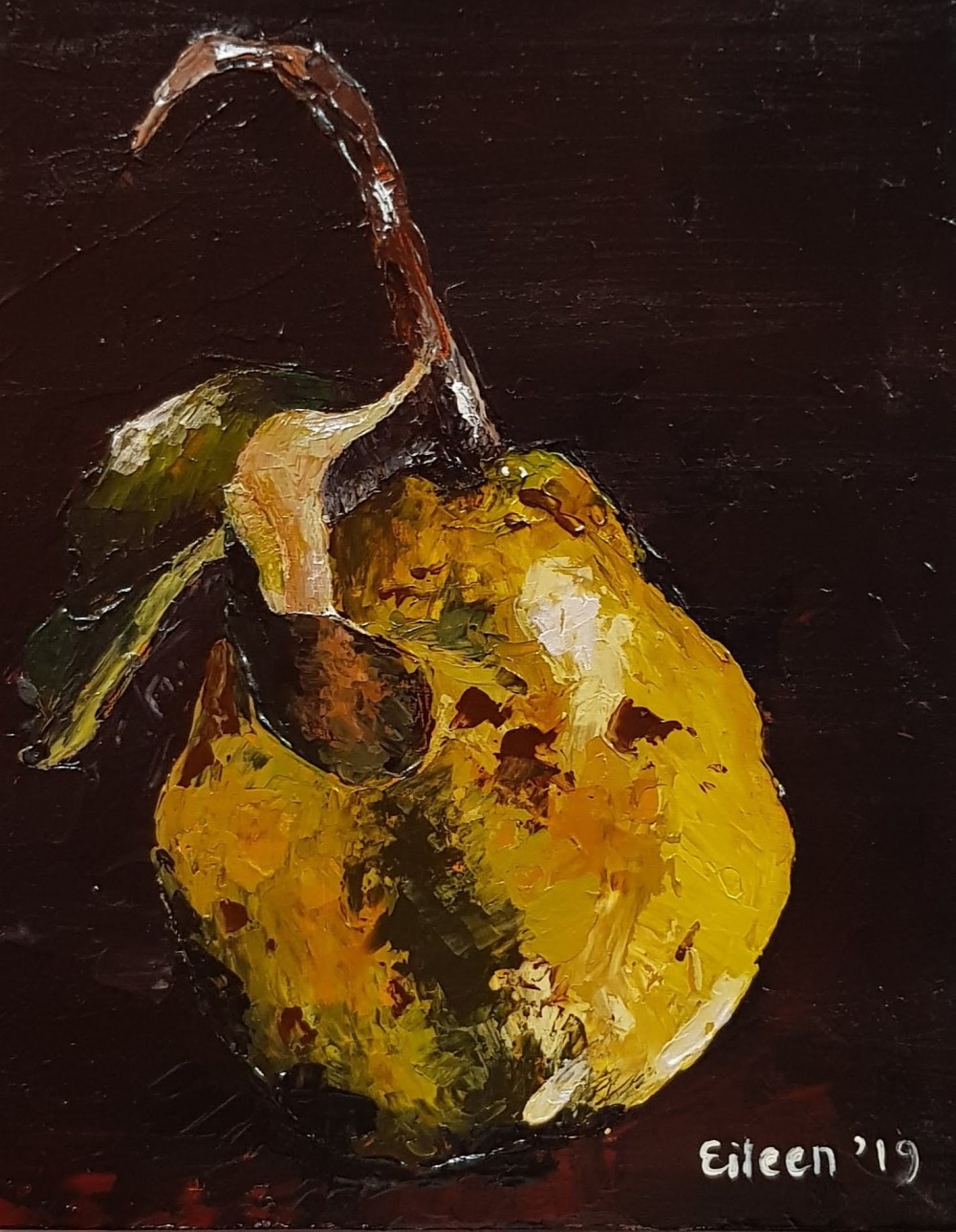
Quince
Acrylic on pressed board
Underpainting in yellow ochre
Application with palette knife only
20 X 25 X 3 cm


Impasto:
Impasto is one of my favourite techniques used in painting, and the palette knife is brilliant for this. Impasto is a method by which paint is laid on an area in very thick layers, usually thick enough that the brush or painting-knife strokes are visible. Paint can also be mixed right on the canvas. When dry, impasto provides texture; the paint appears to be coming out of the canvas. In my peonies for example I combined brush work and the palette knife.
Artists Who Use The Palette Knife:
The palette knife seems to be gaining popularity as artists realize the benefits of it. Here are some artists who make skilful use of the palette knife in their paintings. Sadly living where we do in such a small semi rural area there are no art classes I can attend. Fortunately there is so much available online. Its not quite the same as learning with a group of like minded people with a skilled teacher, but it is better than nothing! The best way to learn is to study how others do it and from there develop your own style and way of doing it. Below are some artists who have most definitely mastered the art of applying paint with a palette knife. Just click on their names, the link is imbedded in the name so should take you directly to the artists web page in a new tab.
-
- Tibor Nagy
- Brent Cotton
- Bato Dugarzhapov
- Daniil Volkov
- Richard Schmid (especially evident in his flower paintings)
 artbyeileen
Inspiring stuff, Eileen! I like to dabble with my small handful of palette knives from time to time though I am not sure my potential customers really appreciate my results at the moment! Yours are excellent, though! You plainly have much more experience than I do! 🙂
Thank you Hilda! I love experimenting and fortunately my current consignment work is giving me the freedom to do so. I will be interested to see if they sell. My husband says if they don’t sell in a month I have to remove them from the store that sells my work, because he wants them to hang in the kitchen! My mother (a water colourist) was very dubious of my fruit. She said they didn’t look very edible!😂😂 I’m not sure my aim was edible, 😊 but it did make me look at the work more carefully. I think I like the pear the least. I’m particularly pleased with the quince. It’s the last one of the 4 so I suspect I had started getting the hang of it by then. The next set of 4 I think I will use a more softer monochromatic palette and try to combine the brush and palette knife rather than use just the palette knife.
I enjoy using a palette knife also, easier to be loose, and to get rough texture. Thanks for underlining the fact that one does not need the whole collection. 🙂
I’m having fun experimenting and playing with palette knives. Its helped me be a little less anal with my brush strokes when I’m not using the palette knife which is a good thing too.