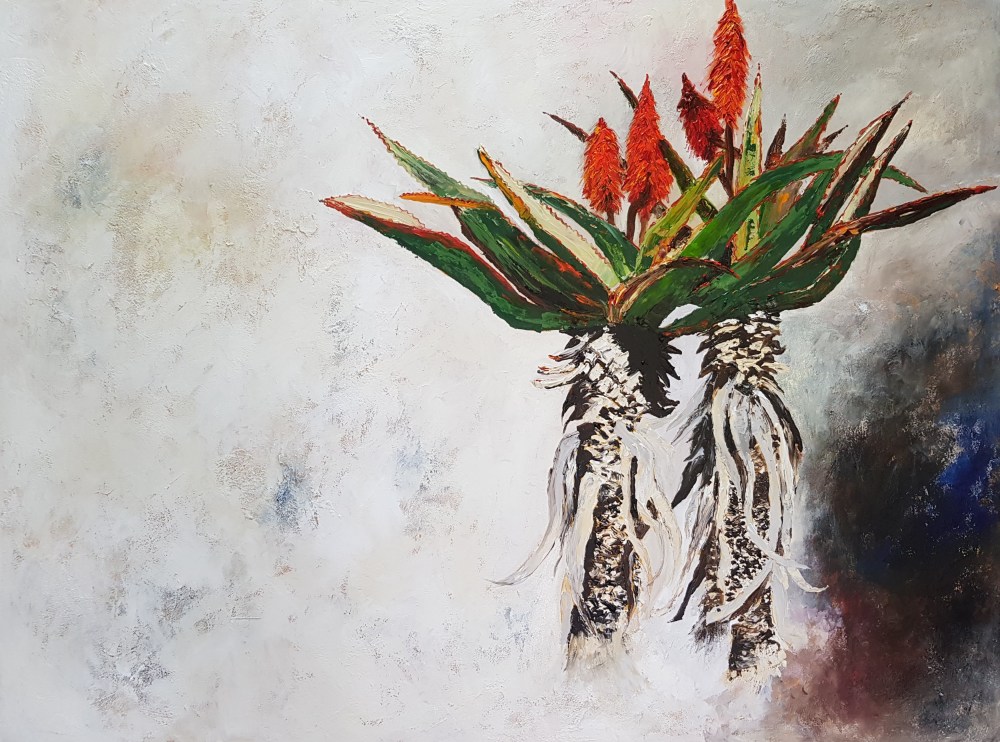
The Hluhluwe Imfolozi Park is just an hour from St Lucia. In that short hour one travels from subtropical dune forest to the Hluhluwe region, which has hilly topography where altitudes range from 80 to 540 metres above sea level. The high ridges support coastal scarp forests, with valley bushveld at lower levels. The north of the park is more rugged and mountainous with forests and grasslands and is known as the Hluhluwe area, while the Umfolozi area is found to the south near the Black and White Umfolozi rivers where there is open savannah.
It is here that one finds an incredible variety of aloe species. Most of us are familiar with Aloe vera, as the most well known of the Aloe species, used as a source for an ingredient in alternative medicine and first aid. In reality there are about 500 different species of Aloe, many of which are indigenous to South Africa.
Aloes are such tangled untidy plants with this rosette of large, thick, fleshy leaves curling up and down in a haphazard mess. Their bright densely clustered tubular flowers in yellows, oranges, pinks, or reds are found at the apex of either a single or a branched leafless stems.
Travelling all over the world these Aloes have always reminded me of home and since living back in South Africa after many years abroad it is wonderful to reconnect with what makes home special!

The background to this painting has been built up with textured mediums from Golden and Liquitex and then painted over with acrylic paint. This gives a very textured background, which to me is synonymous of the environment in which we find Aloes.
Once the background had dried, I began work on the tangled dried mass of dead leaves dangling down the stem. Some of these aloes can live to up to 200 years, so the stems are large, and thick with their historic growth clearly visible. This is so visually textured that I wanted to paint it using only a palette knife.


I was initially going to paint the leaves with a brush to contrast the treatment of the thick stem, with the tangled mass of dying leaves still clinging on to the plant. Instead, I decided to use a palette knife for an impasto treatment of the fleshy, fat aloe leaves, filled with their succulenty sap.


I love how the green fleshiness is balanced on top of the intertwined dying leaves still attached to the stem.


And finally, the bright little pipe shaped flowers, clustered in a vertical mass, on a leafless stalk, looking like bright miniature Christmas trees, on the top of a rather archaic looking plant.
 artbyeileen